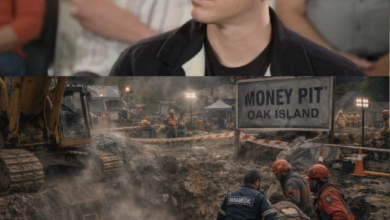
What Rick Lagina Just Confirmed Will Change Everything on Oak Island
Oak Island’s Swamp Secrets: Hidden Roads, Ancient Artifacts, and the Tunnel That Could Change Everything

A Discovery That Shook the Lagina Brothers
In a moment that left Oak Island fans stunned, Rick and Marty Lagina appeared visibly shaken during their latest dig—so much so that they abruptly left the site. What did they uncover in the murky depths of the swamp that made even these seasoned treasure hunters pause?
Their reaction wasn’t just drama—it was driven by a startling new find that might rewrite the island’s 229-year-old mystery. What began with the discovery of a centuries-old coin and ornate button soon led to a web of hidden structures, possible 16th-century trade connections, and perhaps even a long-buried treasure route beneath the swamp.
Gold-Gilded Button & Silver Handle Spark a Chain of Clues
At Lot 5, near the water’s edge, team members Jaime, Kuba, and Fiona unearthed a golden-colored button, believed to be fire-gilded and possibly from a high-ranking 18th-century military uniform. Alongside it was a decorated silverware handle—both rare finds on the island.
High-tech analysis in a modern lab confirmed the button’s golden surface through X-ray fluorescence, while scanning electron microscopy revealed intricate designs, linking it to British naval attire during the era of imperial expansion.

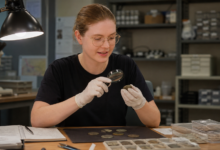


Coin from the Reign of King George III Unveils Deeper Connections
Soon after, a coin believed to date from the era of King George III (1760–1820) was scanned using the Skyscan 1273 CT. The 3D scan pierced layers of corrosion, revealing a monarch’s face and date stamp—clues that this coin may predate the Money Pit itself.
Could these objects have belonged to early treasure hunters? Or were they part of a more strategic operation involving long-distance trade or piracy?
Phoenician Beads and Ancient Pottery Hint at Global Links
Excavations revealed more: a potential Phoenician bead and fragments of Chinese pottery, likely from the 16th century. These findings suggest contact with Portuguese explorers like Vasco da Gama, famed for bringing Eastern treasures to Europe. The design and location of these pieces hinted at a centuries-old trade route touching Oak Island’s shores.

The Swamp’s 500-Year-Old Stone Road: A Concealed Route?
Perhaps the most game-changing discovery came when Gary Drayton, Emma Culligan, and the team unearthed a stone road, hidden beneath the swamp and supported by wood and brush. The structure was sophisticated, hinting at purposeful construction—possibly to move heavy cargo inland from ships.
Large iron chains, hooks, and barrel staves found nearby added weight to the theory that this road may have been used for offloading treasure centuries ago. Its deliberate design and abrupt ending suggested it might lead directly to hidden wealth buried deeper inland.
The Garden Shaft: A Tunnel to Untold Riches?
Attention soon shifted back to the infamous Money Pit and the newly reactivated Garden Shaft. Drilling efforts reached 100 ft, revealing large beams and a mysterious wooden tunnel dating back to the 17th century—older than any structure previously found on Oak Island.
Carbon dating and detailed wood analysis pointed to construction methods consistent with treasure hiding, not farming. A metal detector sweep by Gary Drayton revealed unusual iron pieces—possible tools or fasteners—adding another layer of intrigue.
Was the Swamp Man-Made to Hide Something?
Geoscientist Dr. Ian Spooner examined peat layers in the swamp and confirmed they weren’t naturally formed, suggesting human manipulation. These findings support the theory proposed decades earlier by Fred Nolan that the swamp was artificially created—perhaps to conceal a dam, a tunnel, or even a sunken ship.
Iron spikes embedded in ancient wood, unique fasteners, and rusted hooks all hinted at a once-active structure submerged under layers of mud and time.
A Shipwreck? Evidence of Early Sailors Discovered
Near the swamp’s southern edge, the team found what looked like a medieval ship railing—possibly from the 8th century. Could this be Viking-related? The implications were staggering.

Coupled with the discovery of a dam-like structure beneath the swamp, these finds painted a picture of Oak Island as a landing site for ancient vessels—far earlier than previously imagined.
The Final Breakthrough?
As the crew deepened their dig into the Garden Shaft, new beams appeared—thicker, older, and more strategically placed. The team speculated they were getting close to a tunnel used for hiding treasure. Artifacts continued to surface, including a unique metal piece and wood that could further revise the island’s known history.
A tool mark believed to be made by an adze—a traditional hand tool used in ancient construction—was the final clue in a week of breathtaking revelations.
What’s Next?
With each new artifact and carbon-dated find, Oak Island’s secrets edge closer to the surface. Whether the swamp hides a ship, a treasure vault, or simply the legacy of those who dared to dream, one thing is clear: the mystery is far from over.
Stay tuned, because the best may still be waiting just beneath the mud.