This Actually Just Happened On Oak Island!

Oak Island’s Astonishing New Discoveries Fuel Theories of Ancient Visitors and Lost Treasure
For more than two centuries, Oak Island has been shrouded in mystery, luring treasure hunters from around the world. The Nova Scotia island’s swampy terrain, peculiar stone formations, and tantalizing artifacts have fueled endless speculation about who came here, what they left behind, and why they hid it so well. Now, a new wave of discoveries is pushing the Oak Island team — led by Rick and Marty Lagina — closer than ever to answers that could rewrite history.
A Roman Coin That Defies Time
The season’s first breakthrough came on Lot 5, where a copper coin of suspected Roman or Byzantine origin was unearthed. Numismatist Sandy Campbell analyzed the artifact, dating it between 300 BC and 600 AD. X-ray fluorescence revealed a silver content of 1.05% and arsenic content of 0.51%, suggesting it was minted before 1500.
Even more compelling, the coin’s imagery — a human figure beside a tree — matched stylistic elements from Roman designs. This finding sparked a bold theory: the coin might be linked to ancient Roman roads and sculptures discovered in Portugal, a region where the Knights Templar later established strongholds. Could the Templars have transported such relics to Oak Island centuries later?

Gold Traces in the Garden Shaft
Meanwhile, in the Garden Shaft near the Money Pit, drilling operations conducted with Dumas Contracting revealed gold particles embedded in 55-foot-deep wood samples. Archaeometallurgist Emma Culligan confirmed the findings, with concentrations reaching 0.11% bound to organic material. The discovery suggests the team is within striking distance of a possible treasure chamber, fueling hope that science might finally locate the fabled vault.



18th-Century Glass in the Quadrilateral
On Lot 13, the team’s excavation of a mysterious quadrilateral stone structure revealed 18th-century glass fragments, rusted metal resembling a cannonball splinter, and disturbed soil layers. Experts believe these materials could have been left by earlier treasure hunters — or those who constructed the feature. The purpose of the quadrilateral remains elusive, but its human-made nature is beyond doubt.

A 500-Year-Old Bronze Coin
Gary Drayton and archaeologist Laird Niven struck gold — figuratively — again on Lot 5, discovering a hammered bronze coin possibly dating to the early 1500s. Initially mistaken for a button, the coin’s arsenic content and distinctive carving mark it as an “arsenical bronze” piece, likely from the late medieval period. XRF analysis may confirm its European origin, potentially linking it to early explorers.
Templar Carvings and the Goose Paw Symbol
Theories of a Knights Templar connection gained traction after local historian Isaac Rafuse revealed a stone carving resembling the “goose paw,” an emblem associated with medieval stonemasons loyal to the Templars. Similar symbols have been found in Templar strongholds in Portugal and at other Nova Scotia sites like the Overton Stone. If genuine, such markings could indicate Templar presence on Oak Island between the 12th and 14th centuries.
Peculiar Lead Token From Ancient Trade
Another Lot 5 find — a scalloped lead disc — might be a Roman-era trade token. XRF testing revealed lead with copper, iron, and silicon, possibly originating from Italy or Iran. Its discovery near the Roman coin hints at a broader network of ancient connections.
Brass Door Handle in the Swamp
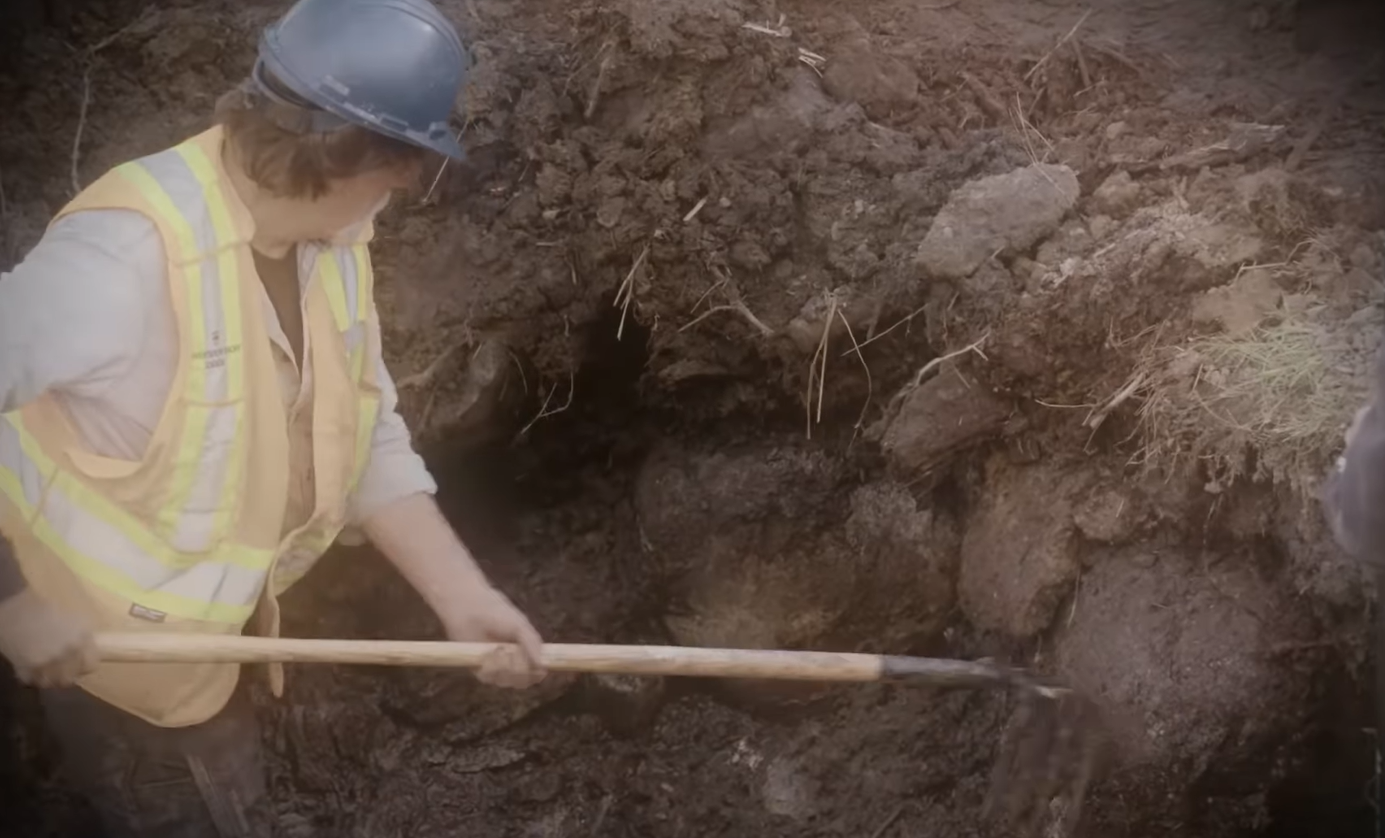
In the island’s triangular swamp, Drayton uncovered a brass door handle, likely from a large sailing vessel. The artifact may support theories that the swamp’s stone ramp and nearby paved area, dated to 800 years ago, served as a landing zone for unloading precious cargo.
A 600-Year-Old Horseshoe
Nearby, excavation revealed a handcrafted horseshoe, dated by expert Carmen Legge to the early 1400s — possibly the oldest metal artifact ever found in the swamp. Its discovery strengthens theories of pre-Columbian transatlantic contact and links to Portuguese maritime activity.
5,000-Year-Old Tools on Lot 26
Perhaps most astonishing of all, iron tools discovered on Lot 26 — resembling hoes or bush axes — were dated by Carmen Legge to an incredible 5,000 years old. Such artifacts predate European settlement by millennia, suggesting that Oak Island may have been visited — and possibly exploited for resources — by ancient peoples long before the modern era.
Italian Caves and the Lead Cross Connection
Seeking answers abroad, Rick Lagina’s team traveled to Camerano, Italy, to explore caves once used by the Knights Templar. Within the complex, they found architectural features identical in shape to a lead cross discovered on Oak Island in 2017. In the Great Simone Cave of Asimo, they also encountered carvings matching symbols from the island’s “H-O stone.” These parallels deepen suspicions that the Templars may have moved sacred treasures across Europe — and ultimately across the Atlantic.
From Roman artifacts to medieval carvings, from traces of gold to tools older than recorded history, the past months have yielded some of the most extraordinary evidence yet that Oak Island’s mystery spans continents and millennia.
Whether these finds will finally lead to the treasure long rumored to be hidden beneath the island remains to be seen. But for the Laginas and their team, one thing is clear: the deeper they dig — both in the ground and into history — the more the island gives up its secrets. And with every discovery, the legend of Oak Island grows stronger.