Hidden Chamber Unearthed on Oak Island — And It’s Not What Anyone Expected.
Concrete Proof? Inside Oak Island’s Latest Find—and Why It Could Change Everything
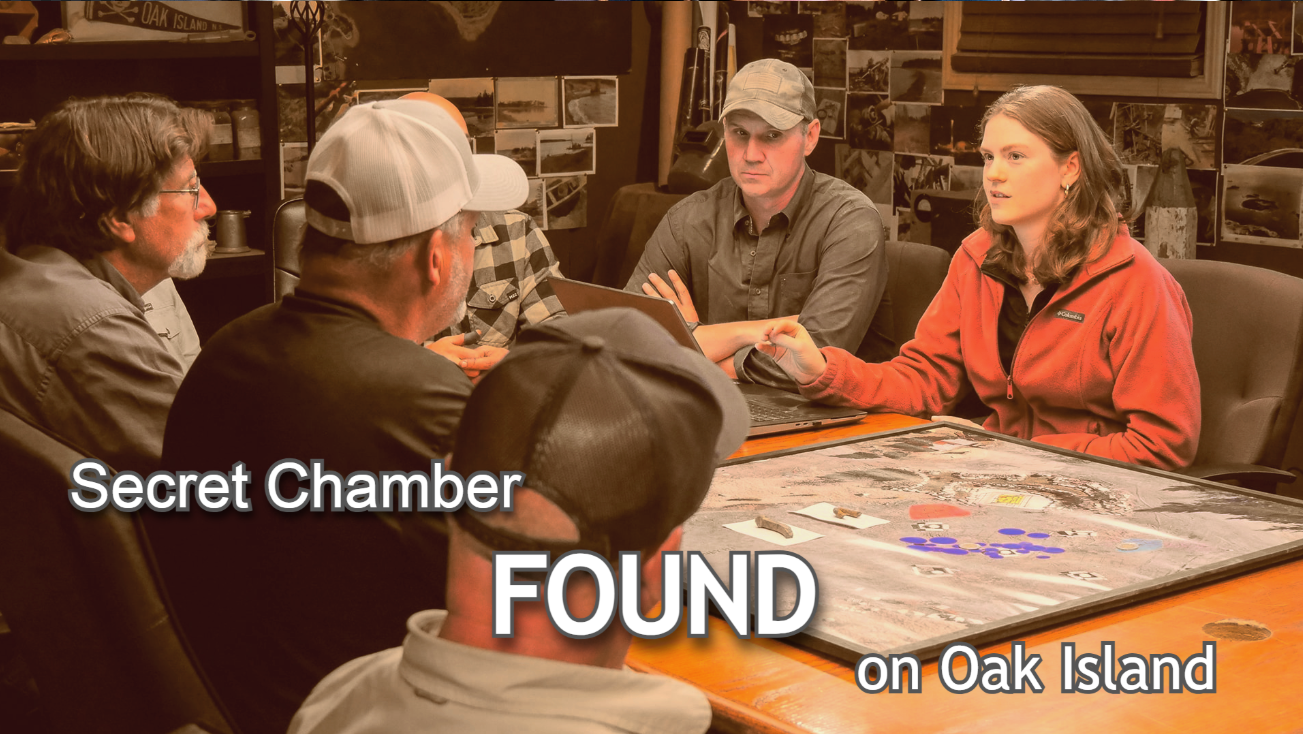
Oak Island, Nova Scotia — After years of speculation, setbacks, and sensational theories, the team hunting for answers beneath Oak Island says they’ve uncovered their most persuasive evidence yet: a man-made structure more than 30 feet down—complete with timber, a rock wall, and mid-20th-century concrete that simply shouldn’t be there by accident.
A Board That Didn’t Belong
It started with a single plank in the muck—one lonely board where no natural process could have placed it. Then came a second. Then a beam. And finally, a slab of concrete. For veteran diggers like Rick and his crew, random lumber doesn’t “just happen” deep underground. It’s a breadcrumb. A hint that someone, at some time, built something—and wanted it hidden well below the surface.
The site sits amid centuries of lore: flood tunnels, decoy shafts, and a “money pit” that has swallowed hopes, fortunes, and more than a little blood and sweat. But this time, the clues were different—more engineered, less accidental.

Enter Emma Culligan—and the Cement Clock
To separate myth from mechanics, the team called in Emma Culligan, a specialist who fuses materials engineering with archaeological method. Her analysis cut through the fog: the concrete contained Portland cement consistent with mixes commonly used from the 1920s to the 1970s, likely sourced in Quebec and set with local Nova Scotia sand and aggregate. In short: human, intentional, and period-specific—not some ancient concretion or modern contamination.



If true, that window lines up with mid-century operations on Oak Island—especially the Restall family’s attempts in the 1960s to choke off the legendary flood tunnels. Did they plug a critical conduit? Did they find something—and seal it? Or did they come within inches, stop short, and leave a hardened signpost for the next generation?
A Rock Wall with a Purpose
Beyond the concrete, the crew documented a wall of stones laid like someone followed a plan. It wasn’t a random cobble scatter; it was aligned, deliberate, and buried. Beneath and alongside it, voids and structural hints suggested a tunnel or chamber—exactly the kind of man-made feature Oak Island lore has promised and skeptics have demanded.
No one on the team celebrated with wild claims. But you could see it in their faces: this felt different. After years of mixed signals, the lines finally seemed to connect—maps, depths, materials, and history all pointing in the same direction.

Why Concrete Matters Here
The presence of concrete is a hinge moment. Nature doesn’t pour a 20th-century mix 30 feet down. Someone brought materials across water, mixed them on site, and placed them where they would be difficult to reach and harder to remove. That takes money, time, logistics, and a compelling reason. Protect a tunnel? Block a floodgate? Hide an entry? Any answer implies design, not accident.
Culligan’s lab work tightened the narrative: local sand and gravel, a regional Portland cement, a historic timeframe that fits known campaigns. The picture that emerges is not of pirates with shovels, but of determined builders—mid-century problem-solvers who believed they were within reach of something worth sealing.
Nolan’s Cross and the Pattern Problem
While the dig pressed on, attention returned to Nolan’s Cross—five cone-shaped granite boulders arranged in a cross pattern and, some argue, shaped or moved by human hands. To believers, it’s a map, a marker, even a spiritual symbol. To skeptics, it’s a triumph of pattern-seeking. The truth may sit somewhere between: the stones might be significant without being mystical, contextual without decoding a treasure map. Either way, their presence keeps the island’s cartography of clues alive—and the crew cautious about reading too much into alignments alone.

What If the Restalls Were Right?
The concrete’s date range reopens an old question: Did the Restalls know more than later hunters realized? If they sealed a critical tunnel, were they trying to protect an excavation, control inflow, or conceal a discovery? And when their work stopped, was it because they were forced to, warned off, or satisfied they’d achieved what they came to do?
These aren’t just romantic questions; they’re operational ones. If the plug marks a choke point in a hydraulic system, today’s team may be standing over the very lever that feeds the island’s most contested voids.
The Stakes—And the Next Move
At more than 30 feet down, every inch of progress is expensive, slow, and risky. But for the first time in years, the evidence reads like an engineered story: boards, beams, a rock wall, and concrete that clocks a specific era. It suggests purpose, not chance. If the team can trace the concrete barrier to a tunnel that aligns with historic maps, they may finally pivot from theory to proof.
No one’s promising chests of gold. Yet the practical reality remains: you don’t mobilize materials and men to build underground unless the ** stakes**—financial, strategic, or historical—justify the effort. On Oak Island, that has always pointed to the same possibility: something worth protecting.
For now, the plan is clear: verify the structure, test the boundaries, and follow the engineered pathway wherever it leads. Whether the end is treasure, technology, or a definitive chapter in the island’s long, tangled history, this concrete clue has turned a legend into a workable problem—and that may be the biggest discovery of all.