Emma Culligan Connects the Dots at Smith’s Cove: And It’s Bigger Than Expected.
Concrete Clues and Buried Secrets: Are Smith’s Cove Discoveries the Key to Solving Oak Island’s Mystery?
For over two centuries, the hunt for treasure on Oak Island has captivated adventurers, historians, and conspiracy theorists alike. But a new wave of discoveries—led by geoscientist Emma Culligan and fueled by advanced technology—may finally change what we think we know about the island’s legendary flood tunnels and the secrets they guard.
A Cement Sample That Changes Everything
During an excavation at Smith’s Cove, Emma Culligan uncovered a cement structure that raised more questions than answers. Using X-ray diffraction (XRD), she identified the cement’s composition—most notably the presence of Portlandite, a key ingredient in Portland cement. Surprisingly, the sample dated back not to the 1700s or 1800s as expected, but to the 1920s–1970s, indicating it was not part of the original treasure deposit.
The evidence pointed to past treasure hunters—particularly the Restall family, who attempted to seal the flood tunnels in the 1960s using Portland cement mixed with local sand. If confirmed, this could be the strongest proof yet that engineered flood tunnels exist beneath the island.
Natural Geology or Man-Made Trap?
Despite compelling evidence, some experts remain skeptical. Oak Island sits atop karst topography, a naturally porous landscape that forms tunnels and sinkholes over time. Could the so-called flood tunnels be nothing more than nature’s work, misunderstood by generations of treasure seekers?

But stacked cobblestones, wooden beams, and carefully aligned box drains found at Smith’s Cove suggest otherwise. One of the most surprising elements was the discovery of coconut husk, a tropical material not native to Nova Scotia. Historically, these husks were used as a filtration medium in booby-trapped flood systems, lending weight to the theory of a deliberately engineered defense mechanism guarding something of value.



A Legacy of Searchers: The Stove Door Discovery
Not all discoveries point to buried treasure—some illuminate the history of the search itself. Metal detection expert Gary Drayton recently unearthed a cast iron stove door, later dated to the mid-1800s via X-ray fluorescence (XRF). This artifact likely belonged to early treasure hunters who camped and lived on the island during harsh winters, showing how far searchers went in pursuit of Oak Island’s elusive fortune.
This wasn’t an isolated find. Past excavations uncovered stove parts, tools, and even evidence of small-scale industry. Could it be that Oak Island once supported a working settlement? Some now believe that, beyond myths of gold, the island holds a history of human resilience and enterprise.
How Technology Is Changing the Game
Gone are the days of blind digging. Today, the Oak Island team utilizes ground penetrating radar (GPR), seismic scanning, and other high-tech tools to map subterranean anomalies. A recent operation set off 18,000 seismic charges to scan for voids up to 300 feet deep.
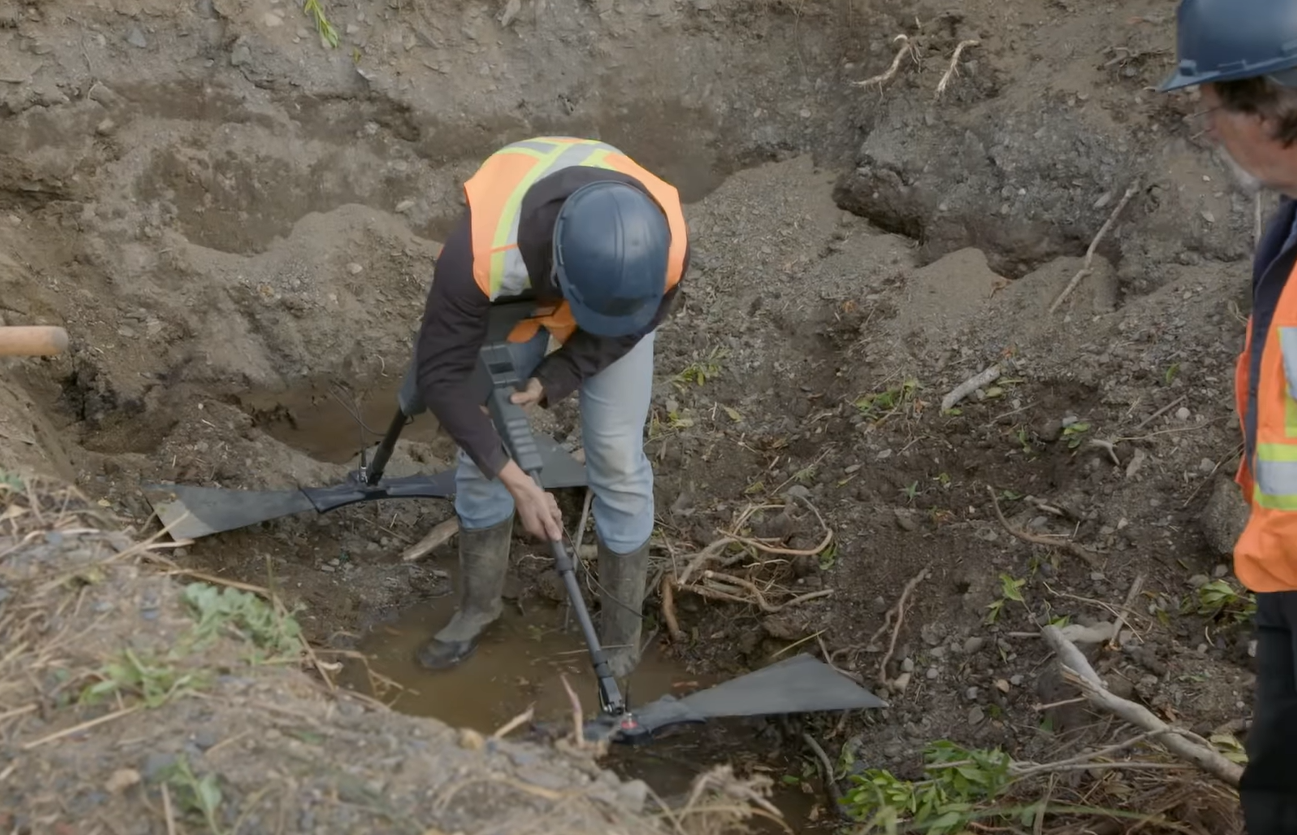
The data suggests possible tunnels connecting the Money Pit to Smith’s Cove—and perhaps to Shaft 9, a suspected key to the treasure’s location. Meanwhile, new finds like a rusty chisel dating back to the 1400s continue to add to the mystery.
A New Chapter in the Oak Island Story
As more evidence surfaces, a bigger picture is emerging. Whether it’s an advanced civilization, 18th-century engineers, or relentless 19th-century searchers, it’s clear that someone went to extraordinary lengths to protect—or pursue—something on Oak Island.
The question remains: Was it treasure? Knowledge? Or simply a misunderstood natural formation misread by hopeful eyes?
What’s Next?
As technology pushes the investigation forward, the Oak Island team stands at a historic crossroads. Will the concrete at Smith’s Cove prove the existence of a man-made flood system? Or is the truth still buried beneath centuries of myth and mud?

One thing’s for certain: the deeper they dig—literally and figuratively—the closer they come to rewriting the history of one of the world’s most enduring mysteries.
What do you think? Could this be the breakthrough we’ve all been waiting for? Share your theories in the comments and subscribe for more updates as the Oak Island mystery unfolds.