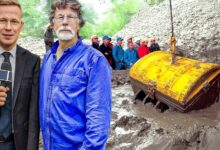
The Money Pit or a Industrial Hoax? Joe Rogan and Researchers Clash Over Oak Island’s Darkest Secrets
For over two centuries, a tiny island off the coast of Nova Scotia has served as the world’s most expensive and deadly Rorschach test. To some, Oak Island is the final resting place of the Ark of the Covenant, Shakespearean manuscripts, or Marie Antoinette’s jewels. To others, it is “Hoax Island”—a geological trap that has swallowed the fortunes of adventurers and the lives of six men.

The saga began in 1795 with a young Daniel McGinnis and a mysterious depression in the ground. Since then, the quest for the “Money Pit” has evolved into a global phenomenon, recently amplified by voices like Joe Rogan and Graham Hancock. While Hancock’s theories of lost civilizations and forbidden knowledge suggest that Oak Island might be a link to an ancient global culture, Rogan has voiced a more cynical perspective. On his podcast, Rogan has questioned how a decade of high-tech searching by the Lagina brothers has yet to produce a definitive “smoking gun,” suggesting the pit might be an elaborate trap designed to lure seekers to their demise.
The legendary “booby traps”—specifically the flood tunnels that have thwarted excavators since the Enlow Company in 1806—are the heart of the mystery. The discovery of a stone tablet at 90 feet, allegedly reading “Forty feet below, two million pounds are buried,” provided the fuel for a 200-year obsession. However, skeptics and scientists are now offering a different, perhaps more grounded, explanation that strips the island of its supernatural veneer.

Retired marine geologist Gordon Fader and historian Joy A. Steele have presented a compelling counter-narrative: Oak Island was never a treasure vault, but the site of a massive British industrial center. Their research concludes that in 1720, the British military and private companies operated pine tar works on the island. In this context, the “Money Pit” was not a treasure shaft but a pine tar kiln used to produce pitch for coating the hulls of British ships. The layers of wood, charcoal, and putty found deep underground are not the leftovers of treasure chests, but the essential components of 18th-century industrial chemistry.
Furthermore, the “booby traps” may be nothing more than basic geology. Fader and geoscientist Steven Aitken point to the island’s karst system—a bedrock of limestone and gypsum prone to natural dissolution. This creates a network of underground caves and sinkholes that flood naturally with the tide. To a frustrated treasure hunter in 1849, a natural sinkhole flooding with seawater looks like an ingenious trap; to a geologist, it is simply the Atlantic Ocean behaving as expected.
Despite these scientific explanations, the allure of Oak Island refuses to dim. Historian Charles Barkhouse argues that the human history on the island is too complex to be pinned to a single theory. From military buttons and 14th-century lead crosses to traces of gold in the water, the “scattered crumbs” of evidence suggest that Oak Island was a crossroads for many groups—be they Templars, pirates, or British engineers.
As the Lagina brothers continue their relentless search into Season 14, the island remains a battlefield between science and faith. If the treasure is real, its discovery would rewrite history. If it is, as Rogan suggests, a grand myth or an industrial relic, then Oak Island stands as the ultimate psychological prank—a giant hole in the ground that reflects the deepest desires and obsessions of everyone who dares to dig. Whether gold or pine tar lies at the bottom, the true “curse” of Oak Island may be the human inability to walk away from a mystery.