Border Security in Britain: A Divided Debate Over Control, Migration, and National Interest
Border security remains one of the most contested and politically sensitive issues in Britain today, shaping public debate, influencing elections, and dividing opinion across communities. At its core, the discussion revolves around a fundamental question: how should the United Kingdom balance national security and economic stability with humanitarian responsibility and global cooperation?
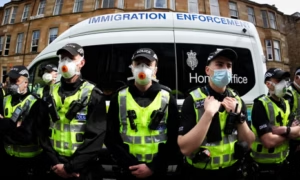
On one side of the debate, supporters of stronger border controls argue that tighter regulation is essential to protect national security and maintain public confidence in the immigration system. They point to increasing pressure on public services such as healthcare, housing, and education as evidence that migration levels must be carefully managed. For this group, border enforcement is not only a political issue but also a practical necessity to ensure that infrastructure and resources are not overstretched.
Advocates of stricter controls also highlight concerns around illegal migration and human trafficking networks. They argue that without robust border enforcement, criminal organisations can exploit vulnerabilities in the system, leading to unsafe and unregulated movement of people. From this perspective, stronger borders are seen as a safeguard for both citizens and migrants, ensuring that entry into the country is controlled, lawful, and transparent.
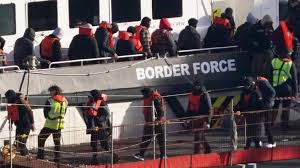



However, there is another equally strong perspective that emphasizes the benefits of migration and international cooperation. Supporters of more open or flexible border policies argue that legal migration contributes significantly to the UK economy, filling labour shortages in key sectors such as healthcare, agriculture, construction, and hospitality. Without migrant workers, many industries would struggle to maintain current levels of productivity and service delivery.
This side of the debate also points to the cultural and social contributions of migration. The UK has long been shaped by international movement, and many argue that diversity strengthens communities, fosters innovation, and supports global connections. From this viewpoint, migration is not a burden but a vital component of national growth and resilience.
Economists and policy analysts often sit somewhere between these positions, acknowledging both the pressures and benefits associated with migration. They note that the impact of border policy depends heavily on how it is managed rather than simply the volume of migration itself. Effective systems, they argue, require clear rules, efficient processing, and targeted policies that respond to labour market needs.
Public opinion in Britain reflects this complexity. Surveys and political discussions frequently show a population divided between concerns about control and recognition of economic necessity. This division has made border security a recurring and emotionally charged topic in political discourse, with policymakers under constant pressure to strike a balance that satisfies both security demands and economic realities.
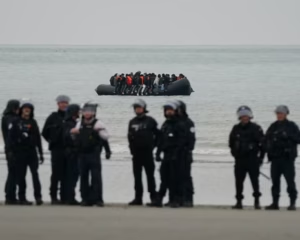
The challenge for government, therefore, is not choosing between open or closed borders, but designing a system that is both fair and functional. This includes addressing illegal migration routes while maintaining accessible legal pathways for skilled workers and refugees. It also involves ensuring that public services are adequately funded and prepared to adapt to demographic changes.
Ultimately, border security in Britain is not a simple binary issue. It is a complex policy area shaped by economics, security, humanitarian obligations, and global interconnectedness. Any long-term solution will likely require compromise, transparency, and ongoing adjustment as conditions evolve.
Where one stands on the issue often depends on which aspect is prioritized—security and control, or economic integration and openness. But what remains clear is that the debate is not disappearing anytime soon. Instead, it continues to define one of the most important and emotionally charged conversations in modern Britain.